Kickers
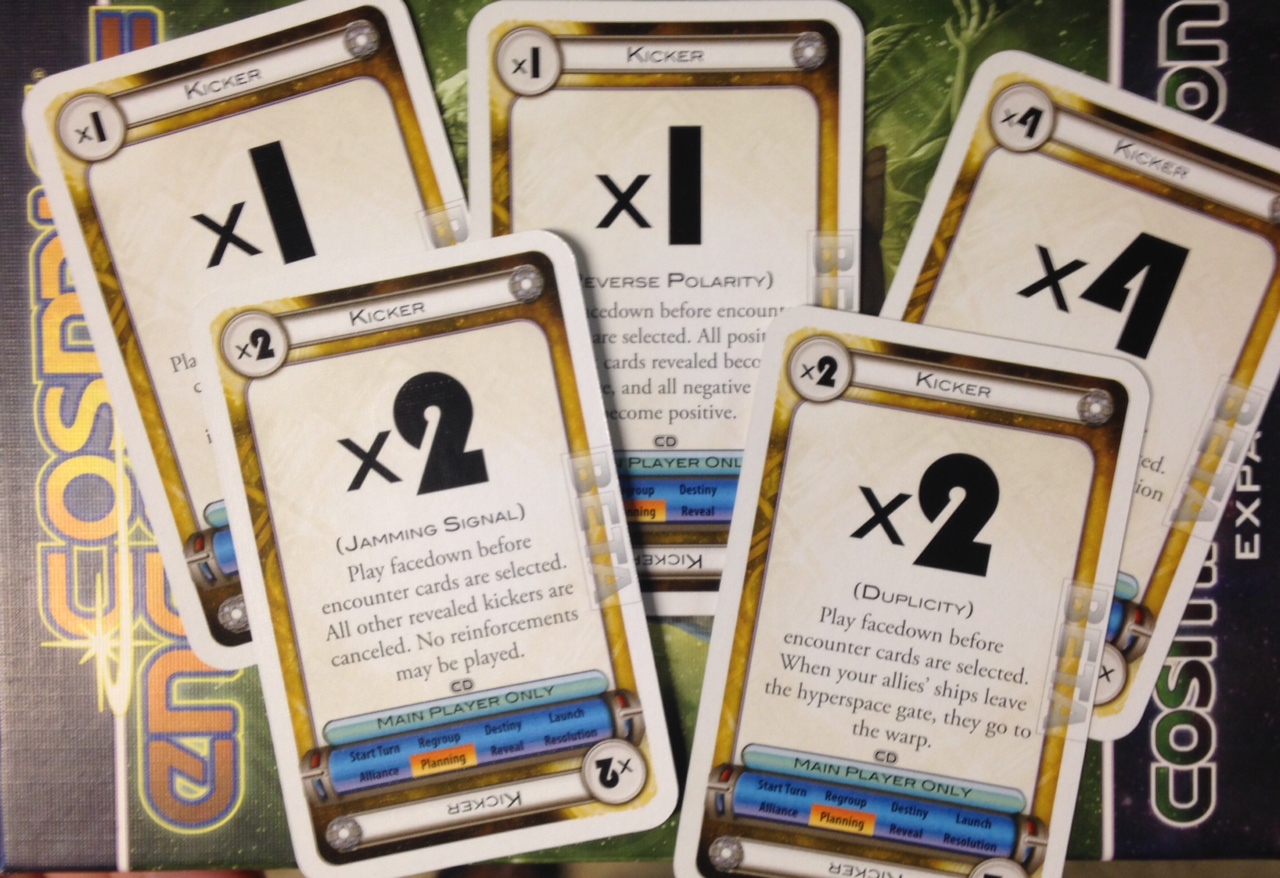 After all alliances have been made and just before encounter cards are played, each main player may play one Kicker card in a encounter, and only main players may play them. To play a Kicker, either of the main players announces that he or she is playing a Kicker and places it face down. If one main player plays a Kicker card, the other main player also gets the opportunity to do so, or reconsider the encounter card or she originally intended to play.
After Kicker cards, if any, have been played, the main players proceed to play encounter cards (Attack or
Negotiate) as usual. When revealing Encounter Cards, turn up Kicker cards as well.
A Kicker acts as a multiplier to the encounter card. If a main player played an Attack Card, he multiplies
the value on the Kicker card by the value on the Attack Card. This multiplication occurs before any similar
alterations take place, such as equalizing by the Calculator or multiplication by the Virus. A negative times
a positive gives you a negative result (example: -8 x 2 = -16), a negative times a negative yields a positive
result (example: -8 x -2 = 16), and anything times zero gives you a total of zero (example: 12 x 0 = 0).
>
 If a player plays a Kicker and a Negotiate Card, and the other main player plays an Attack Card, the
player who played the Negotiate multiplies the value of the Kicker by the number of cards he would
normally take as Compensation, and takes that many cards instead. For example, if a main player played a x3 Kicker card and a Negotiate Card, and lost three tokens in the Encounter, he would take nine cards from his opponent as Compensation (3 x 3 = 9).
If a player plays a negative Kicker and a Negotiate Card, he gives his opponent Compensation, even though
the opponent won the Encounter. In this case, the victor must randomly select the appropriate number of cards
from the loser's hand. If a player lost three tokens while playing a Negotiate and a -2 Kicker, for example,
the winner would draw six cards from the loser (3 x -2 = -6). If a player plays a Kicker and a Negotiate Card, and the other main player plays an Attack Card, the
player who played the Negotiate multiplies the value of the Kicker by the number of cards he would
normally take as Compensation, and takes that many cards instead. For example, if a main player played a x3 Kicker card and a Negotiate Card, and lost three tokens in the Encounter, he would take nine cards from his opponent as Compensation (3 x 3 = 9).
If a player plays a negative Kicker and a Negotiate Card, he gives his opponent Compensation, even though
the opponent won the Encounter. In this case, the victor must randomly select the appropriate number of cards
from the loser's hand. If a player lost three tokens while playing a Negotiate and a -2 Kicker, for example,
the winner would draw six cards from the loser (3 x -2 = -6).
If both players play Negotiate Cards and fail to make a deal, each player multiplies any Kicker he played
by the number of tokens his opponent would normally lose, and his opponent instead loses that number of
tokens. Note that if the Kicker is zero, the opponent loses no tokens. If the Kicker is negative, the opponent
takes tokens from the Warp. Example: the main players fail to make a deal, but the offensive player also played
a x2 Kicker card. Normally, both main players would lose three tokens to the Warp for failing to make a
deal, but instead, the defensive player loses six tokens to the Warp (3 x 2 = 6) and the offensive player still
loses three tokens. It is possible for both main players to take multiplied losses if both played Kicker cards.
Additive Kickers
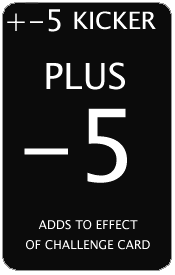
In addition, the Internet Version of CE has Kickers that are additive in nature (you add the value rather
than multiply). Example Kicker +3, and Kicker +-3 (which subtracts). This allows greater usage of Kickers
without as much variation in the totals. There's more bluffing that goes on, and people go through their
hands faster (an important factor when the deck starts to get huge).
In the FFG version of CE, Kickers appear in the Reward Deck in Cosmic Incursion and Cosmic Dominion.
Kickers in Cosmic Incursion:
x0
x2
x2
x3
Kickers in Cosmic Dominion:
x1 Reverse Polarity (All positive attack cards revealed become negative, and all negative ones become positve)
x4 Give War a Chance (Does not affect compensation or failed deals)
x2 Jamming Signal (All other kickers have no effect, and reinforcements can't be played)
x2 Duplicity (Your allies go to the warp)
x1 Self Destruct (Both sides lose)
  
|